
Changes to the Auckland Unitary Plan are coming - here’s everything you need to know so far
📢 Updated November 2025 - This article was originally published in August 2022. Since then, Plan Change 120 was introduced and became operative on 3 November 2025.
2025 Update: Plan Change 120
On 3 November 2025, new natural hazard rules became operative, introducing flood hazard classifications that affect development potential across Auckland.
For comprehensive information on PC120 and how it affects property development:
August 20th is looming fast - the day that many of the Auckland Unitary Plan changes come into effect, as well as the opening of submissions for the next stage of the process. But how exactly will the new reforms affect Auckland residents, real estate agents and developers?
If you want to get a bit of a background to it all - check out our blog from 2021. But for a 2022 update, we spoke to Bayard McKenzie from The Development Collective to get the scoop on all you need to know.
The National Policy Statement - Urban Development 2020 (NPS)
The NPS is the document released in 2020 that is largely responsible for guiding amendments to the Auckland Unitary Plan. See, back in 2015 it was estimated that Auckland would need around 120,000 more houses over the next 20 years that need to be built within the current urban limits. It was determined by the Central Government that there hadn't been sufficient land made available under the current Unitary Plan zoning to achieve the kind of growth Auckland is facing.
So the Government stepped in and basically said that changes needed to be made and upzoning needed to occur right across the city, taking away some of the Council and ratepayers power to oppose a significant portion of the changes. And yes, it's been controversial. But as Bayard explains, there was a reason for it.
"The current zones that were made operative under the Unitary Plan were debated tirelessly during the Unitary Plan Hearings processes back in 2014-2015 and it resulted in the final release not providing sufficiently enough zoned land to accommodate housing supply and accommodate growth. Even though there is a lot of activity and construction in Auckland at present, there is still a lot of existing land within the urban limits of Auckland that is stagnant."
The intent of the NPS was really to allow for land within 1200m of the City Centre, 800m of a metropolitan centre, 600m of Town Centres and 400m of Local Centres to provide for high density housing/apartments where it required four to six storeys as a minimum to be provided for in these areas (as well as the removal of car parking requirements).
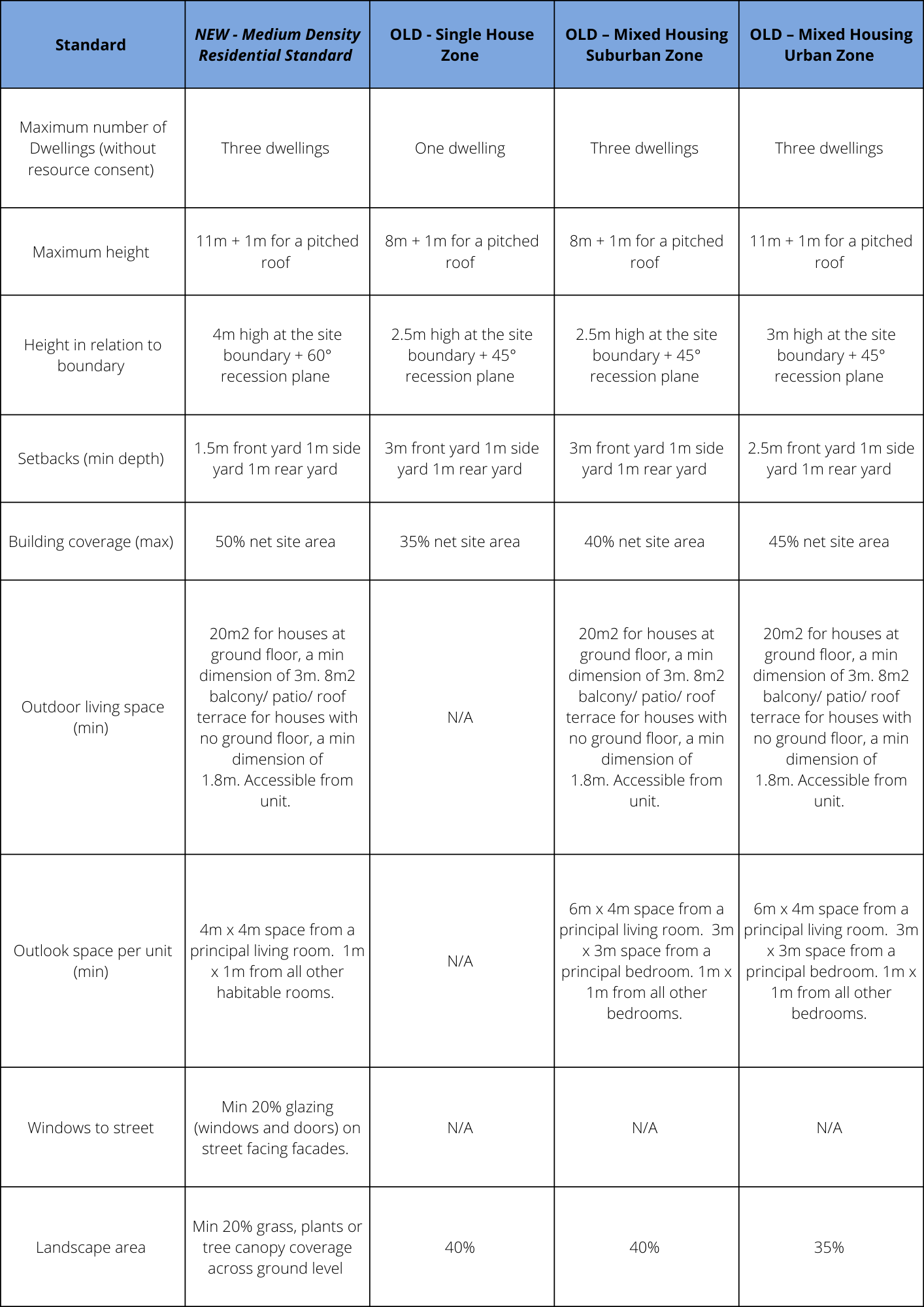
The new MDRS (Medium Density Residential Standards), which comes into immediate legal effect on the 20th of August 2022, was created by the Resource Management (Housing Enabling) Act 2021 and followed on from the NPS. This legislation will allow three houses to be built on most traditional single housing sites, increase the site coverage percentage and permit a greater height to boundary ratio (from two levels to three) 'as of right'.
For full details on the changes - see the summary of changes table from Bayard below.
Qualifying Matters explained
Of course in some situations, exceptions need to be made to certain sites across Auckland, and this is what is known as 'Qualifying Matters'. There are a range of Qualifying Matters that will be included as overlays in the notified planning maps, from anything that is of national significance like ecological areas, to heritage/character homes and where there isn't sufficient infrastructure to support the development.
"I foresee the recommended Qualifying Matter areas as being one of the biggest topics up for debate when the notified version of the plan is released to public in August, especially in terms of protecting heritage/character homes and suburbs," says Bayard
"There are a lot of organisations/residents in Auckland who will likely challenge any potential development on land that has for example character houses and sites they see as significant - and so from the 20th of August when notified plans are released to the public for public consultation, those objecting to the changes will have till around mid next year to make a formal submission for or against the recommended plan changes."
Bayard thinks there will be reasonable chunks of Auckland which will likely fall under the Qualifying Matters overlay, but it's yet to be seen how far they will be enforced.
Where to from here…?
As mentioned above, from August 20th the MDRS will come into immediate legal effect. Bayard says many of his clients are already designing for this change, with one developer happy that it is going to take at least four months off his usual design/build schedule.
Then the next round of consultation will begin on the wider zone changes, amended standards and sites identified as Qualifying Matters. There will be a submission process up until mid 2023, then Hearings will be held by an elected Independent Hearings Panel (IHP) to make the final decisions. What's key here though is that while it will be the Council and IHP tasked with establishing these new swathes of changes, it's the Government who gets final sign-off.
"There's also a big unknown surrounding the development of light rail, with the land around these areas currently "under investigation". This means there may be large swathes of land that will have to remain under current zoning because the investigation work associated with the Light Rail Corridor has not been completed - and won't be for some time.
"This could certainly be a little frustrating, as it may mean many suburbs (for example, Sandringham) where developers could contribute to increasing housing supply, could simply be forced to wait" explains Bayard.
2025 Update: Since 2022, Plan Change 120 was introduced, adding natural hazard considerations that developers and property owners must now account for alongside zoning rules. Learn more about PC120's current status →
The effect on developers
At the end of the day though, things are looking good for Auckland property developers and for those looking to solve some of the issues surrounding the housing shortage crisis.
"Without the need for planning permission for up to three dwellings, you can go straight from design concept to building consent so yes, most of the property developers we talk to are very pro what is happening. Infill housing, from a purely economical view, is far more palatable than our current environment of needing consent for one or two houses within certain zones under the current Unitary Plan."
But Bayard realises that it may be hard for some residents to take and could lead to some poor outcomes.
"For those with a next door neighbour who can suddenly go up to three levels where there is little design control, it could be a big change. But the point to consider for those existing land owners is that there is a considerable part of the population who currently cannot afford a house, but they desperately want to own their own property. This change will go some way in making it more possible for them."
Projects and planning
So what's Bayard's advice for developers who aren't sure how these changes will affect them and their projects? Speak to someone who knows the ins and outs of the Unitary Plan, NPS and MDRS.
"The best thing to do is engage an architect and/or town planner, just to double check your site and ensure that it meets the new standards and doesn't fall within those Qualifying Matters. They should be familiar with the new standards coming into effect in August. But other than that, it's no different to the current process - speak to an expert about what you can do on the site and get started on the design."
And while the opportunity to build within those new perimeters doesn't begin until the 20th of August, there's no reason you can't get a head start and begin designing now.
"The continued need to increase housing supply in Auckland is a great opportunity for property developers as the market starts to stabilise over the coming months" says Bayard.
"We'll definitely be watching closely."
If you have questions about how Auckland's planning rules affect your property or development plans, please don't hesitate to get in touch with our team here at Relab. For information on Plan Change 120 and flood hazards, visit our PC120 resource hub.
This article was originally published in August 2022 and updated in November 2025 to reflect Plan Change 120.
Imagery has been provided by The Development Collective.