

For Agents
21 min read
SEO for Real Estate Agents – How to drive more traffic to your real estate blog or website
Digital marketing for your real estate business simply means making the most out of the online space to both attract new clients and maintain and enhance your brand.
A big part of digital marketing is content creation. This means the content you have on your real estate blog and website.
There's a few things you can do to make sure you're found above your competitors when a prospect searches for an agent. One of those is SEO.
So, let’s talk SEO (search engine optimization) for Real Estate professionals.
SEO needn’t be scary! It’s simply a set of things that you “should” do when it comes to helping the search engines find your website and get it popping up in the SERPs (search engine results pages).
As a real estate agent – you want to make sure that prospective clients are visiting you website and not your competitors! Here’s where SEO can help.
SEO stands for search engine optimization. This means helping the search engines like Google and Bing find your content. Then encouraging those search engines to display your content as top results when someone searches for a particular word or phrase applicable to your real estate business.
SEO is a non paid, or organic form of traffic generation. THE BEST KIND in my humble opinion. Organic traffic means that you have not paid for ads to generate an audience to your site. It simply means people have found you via organic means.
There’s a whole heap of ways you can get traffic to your real estate website and a lot of these are paid. Google ads, Facebook promos, retargeting, display ads, are all some of the paid ways people tend to use to drive visitors to their Real Estate sites.
While paid traffic is still good traffic, as it is usually pretty highly qualified (meaning not random, but specific to your particular topic and niche) … it can be costly! And, when you stop paying… the traffic usually stops along with it.
Organic traffic on the other hand is long lasting. It is free and it is also usually really specific to your niche.. If you’ve done your SEO correctly.
Keywords are in essence the search term that someone enters into a search engine to find relevant answers to their queries.
The first thing to figure out is WHO is your ideal or target customer. What do they look like? And what exact problem are you solving for them as their agent?
Let’s say – your ideal customer is Sally, she’s a soccer mom to 2 girls, aged 7 and 9. She owns a property near the beach. She has two large dogs. She’s smart, she is a single parent. She works long hours in her own design business. She has no mortgage and she makes a very decent 6 figure income.
So, when Sally is looking for a realtor she might search for the following things...
➡ A realtor who is highly experienced- she's time poor
➡ A realtor who is empathetic and understanding of her time - she juggles multiple things
➡ A realtor who is not necessarily the cheapest- but is the best
➡ A realtor who understand kids... and pets ...
In terms of her online search …. the following words… or search terms might make an appearance
▶️ Highly experienced realtor
▶️ Real estate agent good with pets
▶️ Best realtor in x city
▶️ Female realtor in X city
Or, while Sally’s preparing her home for sale she might search for ...
🔎 Ways to stage a home
🔎 Tips on finding an experienced realtor
🔎 How to streamline the property selling process
🔎 How to move home with pets
🔎 How to do open homes with kids
Knowing this stuff means that you know what Sally might be searching for online. Which is fabulous news! Now all you have to do is make sure your content matches up nicely with Sally’s thought processes and pain points. You see, she's NOT just looking for an agent to sell her house. She's looking for someone to take her problems away!
The next thing you can do is take your list of great keyphrases you think your customers will be searching for and give it a little test drive…
You do this by plugging it into a search engine… let's take a looksie.
Immediately when I type in How to stage a house for sale on Google
… I get this result as I type
![Google search results]()
And, then I get a results page like this....
![Google serps]()
Which gives us some good clues as to what’s ranking and what keywords are being used.
Next up… pop that key phrase into a tool like Ubersuggest (there’s a great free version).
Here you can see the overall difficulty a particular keyword will have… plus a heap of other really interesting and useful info like the age range of searchers and what months this search was popular. Great info to have for content planning!
![example of keyword overall difficulty]()
You’ll also get a list of suggested keywords… which you can export. Super handy!
Plus, a list of the top SERPs. Which is basically a list of your top competitors.
One of the best things here though is this! A list of content ideas. Oh my! Such a brilliant tool. You now know your keywords and how difficult it might be to rank with them… AND you get a list of possible topics you could write on your blog or tweak to fit your niche to start your content marketing efforts.
Ok, so that’s a few ways to find out what your customers are searching for and what you might like to target and also write about. You can use this exact same strategy on Pinterest in their search function as well. Which for property and real estate related searches might be even better than Google!
There’s a few other things that are pertinent to mention when it comes to SEO for beginners.
So, it’s one step to know what your ideal client might be searching for and then cater to that. But, there’s also another factor to SEO that’s vital to your success.
Your website.
First up… make sure it’s a great experience. There’s two things here UX and UI. UX stands for User Experience and UI stands for User Interface.
Focusses on all the things a user might experience on your site. How they go from one place to the next.. The pop ups they encounter.. The great stuff and the not so great stuff.
Think easy. Think spacious. Think super intuitive when it comes to UX.
And definitely think NOT ANNOYING!
Great UX leaves a user feeling great about your brand and in Real Estate - your brand is your business!
Is more about the look. It’s about the aesthetics of design and any buttons, widgets and boxes a human might interact with on your site.
UX is brains and UI is beauty.
You want to make sure you're creating an aesthetically pleasing web experience for your readers and that you’re also focusing on making sure the flow for a user is intuitive and natural. Great design is simple.
A site with great UX and UI will mean your visitors stay longer, click on more pages, and go on to become loyal fans and referrers... good right!
This is where things get fancy! But it’s still easy if you know a few tips.
On page SEO means that with each piece of content or page you are creating that you make sure that you are optimizing it for search.
The first is simple.
Make sure your page is easy to skim.
Handy things like using H1 and H2 headers, using lists, using a table of contents, bold headers and H3 headers.
Lots of white space.
Imagery that makes sense for the topics you're discussing and finally, that ole' chestnut UI.
Those keywords you now have in your hot wee hand… we need to get those onto your page.
You’ll want to make sure your keywords are in these places:
A word of caution… don’t keyword stuff. Make it natural. Far better to naturally use keywords in your article than make them stand out like a sore toe. Google is smart!
Once you have your blog written check it for your SEO components. There are handy tools you can use to help you here. I use Yoast SEO, which is a super handy plugin for WordPress.
Yoast looks something like this.
![]()
When adding Alt text and title to images also make sure that they make sense! So Google knows what they are.
![]()
Also, make sure your images are not huge in size. Google doesn’t like it when your page takes ages to load and large file sized imagery can increase your page load speed. You can use a plugin called Smush to decrease the size of all your site images, while maintaining their integrity.
Finally, make sure you create compelling and clickable Metadata!
Metadata is the stuff that you see in search results that tells you what a page/ result is all about.
![]()
Ways To Home Stage A House | Home Styling Sells Houses is the title and the text below is the meta description.
This is what you need to pay attention to when you have completed your article on your blog.
Make sure you have a short (ish) URL, a catchy title that takes keywords into consideration and an accurate and appealing description, that also contains your keyword.
You also want to make sure you use all the space in your meta description!
You can increase your Google juice by adding in one or two high authority outbound links to your blog posts. These are links to sites that are relevant to what you might be talking about. High authority just means they are reliable and sound sites that you recommend. Forbes for example is a great high authority site that Google will recognize as legit.
Then add in some internal links. Links to other pages on YOUR website. This makes it easy for Google to find links to your other content and increase your validity that you’re an expert in your field. Supppeerrrrrr important in real estate.
Finally, you want to make sure you’re thinking of building your inbound link strategy. Simply put; other reputable, high authority sites that contain links TO your blog content and website. In other words.. you want other people to talk about you in a good way online and link to your blog and website. Read more about in depth backlining strategies here.
This is by no means an exhaustive list of SEO tactics for Real Estate Agents/ Salespeople, but hopefully is a good start.
Understanding the basics of SEO for your Real Estate blog or Real Estate website is the first step towards getting more traffic to your site!
Which means more business for you!
A big part of digital marketing is content creation. This means the content you have on your real estate blog and website.
There's a few things you can do to make sure you're found above your competitors when a prospect searches for an agent. One of those is SEO.
So, let’s talk SEO (search engine optimization) for Real Estate professionals.
SEO needn’t be scary! It’s simply a set of things that you “should” do when it comes to helping the search engines find your website and get it popping up in the SERPs (search engine results pages).
As a real estate agent – you want to make sure that prospective clients are visiting you website and not your competitors! Here’s where SEO can help.
What exactly is SEO and why should you care as a Real Estate Agent?
SEO stands for search engine optimization. This means helping the search engines like Google and Bing find your content. Then encouraging those search engines to display your content as top results when someone searches for a particular word or phrase applicable to your real estate business.
SEO is a non paid, or organic form of traffic generation. THE BEST KIND in my humble opinion. Organic traffic means that you have not paid for ads to generate an audience to your site. It simply means people have found you via organic means.
There’s a whole heap of ways you can get traffic to your real estate website and a lot of these are paid. Google ads, Facebook promos, retargeting, display ads, are all some of the paid ways people tend to use to drive visitors to their Real Estate sites.
While paid traffic is still good traffic, as it is usually pretty highly qualified (meaning not random, but specific to your particular topic and niche) … it can be costly! And, when you stop paying… the traffic usually stops along with it.
Organic traffic on the other hand is long lasting. It is free and it is also usually really specific to your niche.. If you’ve done your SEO correctly.
What are Keywords? The basics ...
Keywords are in essence the search term that someone enters into a search engine to find relevant answers to their queries.
The first thing to figure out is WHO is your ideal or target customer. What do they look like? And what exact problem are you solving for them as their agent?
Let’s say – your ideal customer is Sally, she’s a soccer mom to 2 girls, aged 7 and 9. She owns a property near the beach. She has two large dogs. She’s smart, she is a single parent. She works long hours in her own design business. She has no mortgage and she makes a very decent 6 figure income.
So, when Sally is looking for a realtor she might search for the following things...
➡ A realtor who is highly experienced- she's time poor
➡ A realtor who is empathetic and understanding of her time - she juggles multiple things
➡ A realtor who is not necessarily the cheapest- but is the best
➡ A realtor who understand kids... and pets ...
In terms of her online search …. the following words… or search terms might make an appearance
▶️ Highly experienced realtor
▶️ Real estate agent good with pets
▶️ Best realtor in x city
▶️ Female realtor in X city
Or, while Sally’s preparing her home for sale she might search for ...
🔎 Ways to stage a home
🔎 Tips on finding an experienced realtor
🔎 How to streamline the property selling process
🔎 How to move home with pets
🔎 How to do open homes with kids
Knowing this stuff means that you know what Sally might be searching for online. Which is fabulous news! Now all you have to do is make sure your content matches up nicely with Sally’s thought processes and pain points. You see, she's NOT just looking for an agent to sell her house. She's looking for someone to take her problems away!
Keyword research
The next thing you can do is take your list of great keyphrases you think your customers will be searching for and give it a little test drive…
You do this by plugging it into a search engine… let's take a looksie.
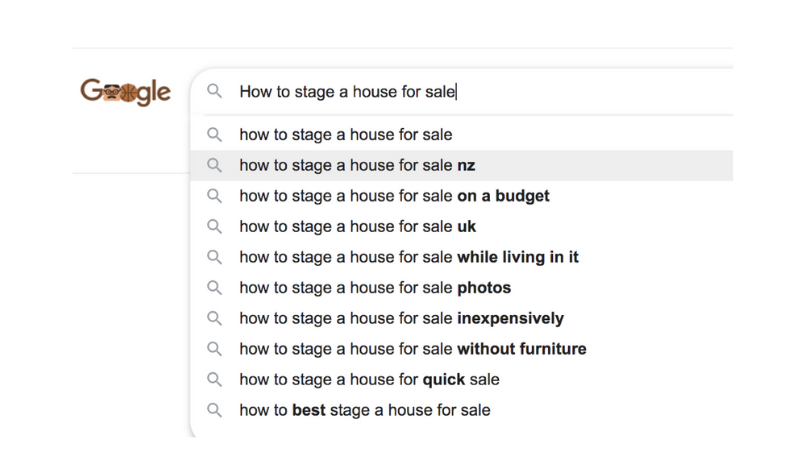
Immediately when I type in How to stage a house for sale on Google
… I get this result as I type
And, then I get a results page like this....
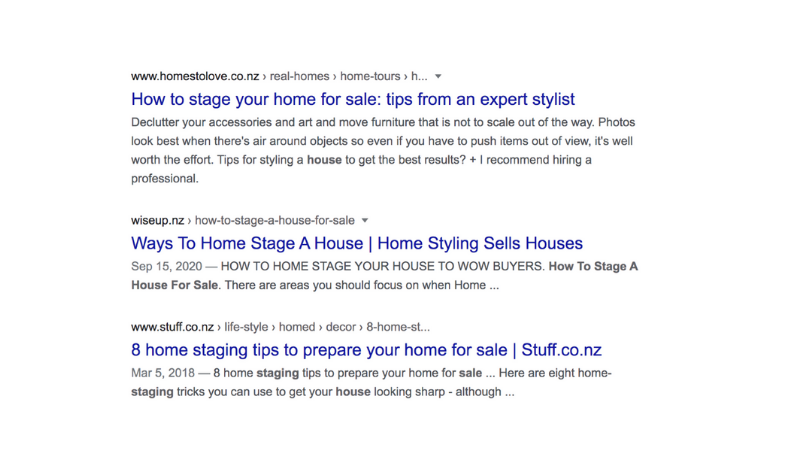
Which gives us some good clues as to what’s ranking and what keywords are being used.
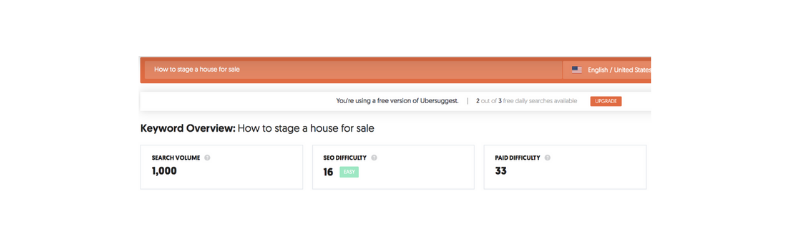
Next up… pop that key phrase into a tool like Ubersuggest (there’s a great free version).
Here you can see the overall difficulty a particular keyword will have… plus a heap of other really interesting and useful info like the age range of searchers and what months this search was popular. Great info to have for content planning!
You’ll also get a list of suggested keywords… which you can export. Super handy!
Plus, a list of the top SERPs. Which is basically a list of your top competitors.
One of the best things here though is this! A list of content ideas. Oh my! Such a brilliant tool. You now know your keywords and how difficult it might be to rank with them… AND you get a list of possible topics you could write on your blog or tweak to fit your niche to start your content marketing efforts.
Ok, so that’s a few ways to find out what your customers are searching for and what you might like to target and also write about. You can use this exact same strategy on Pinterest in their search function as well. Which for property and real estate related searches might be even better than Google!
There’s a few other things that are pertinent to mention when it comes to SEO for beginners.
On site optimisation
So, it’s one step to know what your ideal client might be searching for and then cater to that. But, there’s also another factor to SEO that’s vital to your success.
Your website.
First up… make sure it’s a great experience. There’s two things here UX and UI. UX stands for User Experience and UI stands for User Interface.
UX
Focusses on all the things a user might experience on your site. How they go from one place to the next.. The pop ups they encounter.. The great stuff and the not so great stuff.
Think easy. Think spacious. Think super intuitive when it comes to UX.
And definitely think NOT ANNOYING!
Great UX leaves a user feeling great about your brand and in Real Estate - your brand is your business!
UI
Is more about the look. It’s about the aesthetics of design and any buttons, widgets and boxes a human might interact with on your site.
UX is brains and UI is beauty.
You want to make sure you're creating an aesthetically pleasing web experience for your readers and that you’re also focusing on making sure the flow for a user is intuitive and natural. Great design is simple.
A site with great UX and UI will mean your visitors stay longer, click on more pages, and go on to become loyal fans and referrers... good right!
On page SEO
This is where things get fancy! But it’s still easy if you know a few tips.
On page SEO means that with each piece of content or page you are creating that you make sure that you are optimizing it for search.
The first is simple.
Layout
Make sure your page is easy to skim.
Handy things like using H1 and H2 headers, using lists, using a table of contents, bold headers and H3 headers.
Lots of white space.
Imagery that makes sense for the topics you're discussing and finally, that ole' chestnut UI.
Keyword use
Those keywords you now have in your hot wee hand… we need to get those onto your page.
You’ll want to make sure your keywords are in these places:
- Your blog title
- Your intro paragraph
- Some of your H2 Headers
- 1 or 2 of your image titles or alt tags
- A few times (naturally) in your main paragraphs
A word of caution… don’t keyword stuff. Make it natural. Far better to naturally use keywords in your article than make them stand out like a sore toe. Google is smart!
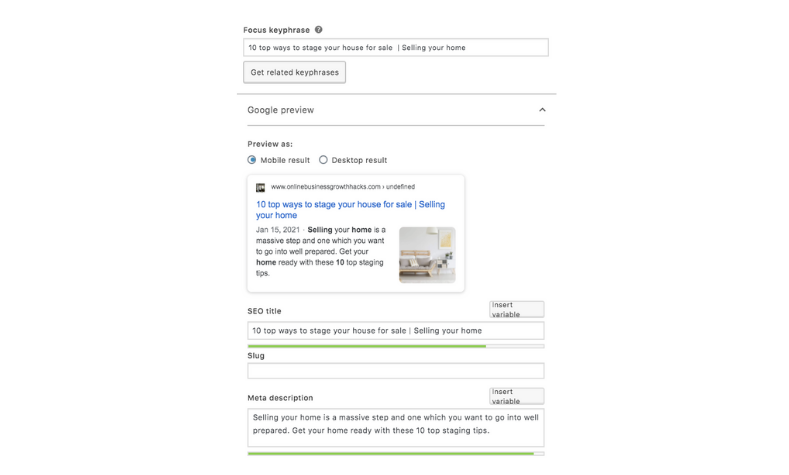
Once you have your blog written check it for your SEO components. There are handy tools you can use to help you here. I use Yoast SEO, which is a super handy plugin for WordPress.
Yoast looks something like this.
When adding Alt text and title to images also make sure that they make sense! So Google knows what they are.
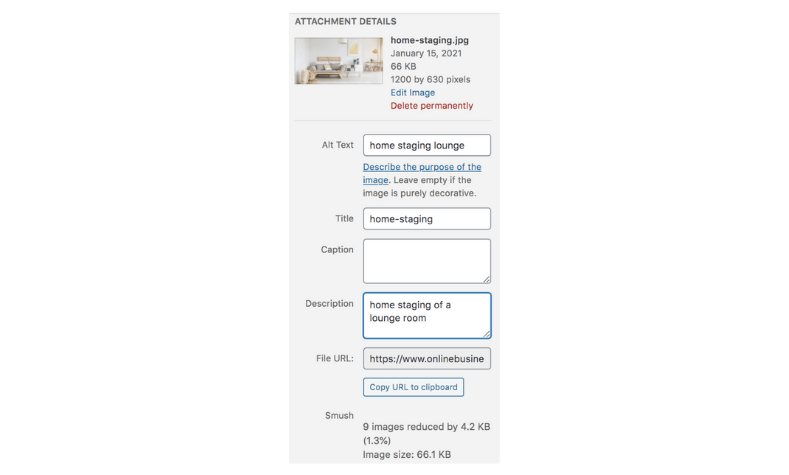
Also, make sure your images are not huge in size. Google doesn’t like it when your page takes ages to load and large file sized imagery can increase your page load speed. You can use a plugin called Smush to decrease the size of all your site images, while maintaining their integrity.
Metadata
Finally, make sure you create compelling and clickable Metadata!
Metadata is the stuff that you see in search results that tells you what a page/ result is all about.

Ways To Home Stage A House | Home Styling Sells Houses is the title and the text below is the meta description.
This is what you need to pay attention to when you have completed your article on your blog.
Make sure you have a short (ish) URL, a catchy title that takes keywords into consideration and an accurate and appealing description, that also contains your keyword.
You also want to make sure you use all the space in your meta description!
Page links
You can increase your Google juice by adding in one or two high authority outbound links to your blog posts. These are links to sites that are relevant to what you might be talking about. High authority just means they are reliable and sound sites that you recommend. Forbes for example is a great high authority site that Google will recognize as legit.
Then add in some internal links. Links to other pages on YOUR website. This makes it easy for Google to find links to your other content and increase your validity that you’re an expert in your field. Supppeerrrrrr important in real estate.
Finally, you want to make sure you’re thinking of building your inbound link strategy. Simply put; other reputable, high authority sites that contain links TO your blog content and website. In other words.. you want other people to talk about you in a good way online and link to your blog and website. Read more about in depth backlining strategies here.
Wrap up
This is by no means an exhaustive list of SEO tactics for Real Estate Agents/ Salespeople, but hopefully is a good start.
Understanding the basics of SEO for your Real Estate blog or Real Estate website is the first step towards getting more traffic to your site!
Which means more business for you!