
Selling flood-zone properties: Pricing, buyer confidence, and honest marketing
Selling properties in a flood-risk area can feel like walking a tightrope —buyers worry about safety and resale, insurers raise red flags, and vendors are terrified of price damage.
After the January 2023 floods, and with Plan Change 120 (PC120) strengthening how natural hazard risk (including flooding) is managed in the Auckland Unitary Plan, these concerns are no longer hypothetical. Buyers, banks and council are all looking harder at flood-affected sites.
With the right approach you can still guide the process to a safe, clean sale —using honest disclosure, evidence-based pricing and calm, confident marketing.
In case you missed it, here's the first article in this sequence: "Winning vendor trust in a flood zone: A guide for proactive agents." And don't forget that new customers to Relab can sign up for a 14-day free trial.
In this article we'll cover the three big levers you control:
- Pricing
- Buyer confidence
- Marketing
…and how PC120 and the new flood hazard context fit into each.
Pricing with precision (not guesswork)
Flood risk isn't the same everywhere. Some properties have minor overlays with limited market impact; others sit in floodplains or major overland flow paths with real constraints, higher insurance costs, or tighter council scrutiny. Your job is to help vendors set evidence-based expectations.
Do the homework before you talk numbers
Before you give any price guidance:
- Use Relab to:
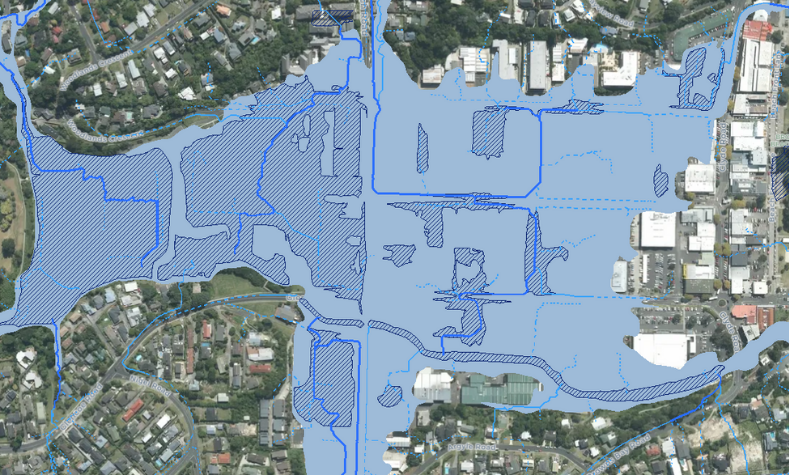
- Turn on the flood hazard map layer (floodplains, flood prone areas, overland flow paths).
- Add services and contours overlays to understand drainage and infrastructure constraints alongside zoning and sales data.
- Cross-check with Auckland Council tools:
- Flood Viewer for a simple public view of floodplains, flood prone areas, overland flow paths and coastal inundation.
- GeoMaps for model age, climate assumptions, catchment sizes and peak flows.
- Review the LIM and property file for:
- Historical flooding or drainage complaints.
- Any flood risk assessments or categorisation reports on file.
Factor in the PC120 natural hazard framework
Under PC120's proposed changes to E36 Natural Hazards, Auckland is moving to a risk-based framework:
- Natural hazard risk (including flooding) is described as Significant, Potentially tolerable or Acceptable.
- For new subdivision, use and development, council aims to avoid significant risk, and only enable development where risk is tolerable or acceptable.
- There is a clear focus on maintaining the function of floodplains and overland flow paths and favouring more nature-based solutions.
Practically, this means that sites in floodplains, key overland flow paths and some coastal hazard areas may face more scrutiny at consent time. For buyers with development or intensification aspirations, that planning risk is now part of pricing.
Turn that into clear, grounded pricing advice
When you sit down with the vendor, cover:
- Comparable sales – use sales of similar properties with similar flood overlays and planning constraints, not just nearby "clean" sites.
- Price vs risk trade-off – explain how:
- Higher insurance premiums, excesses or exclusions
- Floodplain/overland flow constraints
- PC120-related natural hazard restrictions
- Disclosure impact – position transparent flood and PC120 information as a pre-emptive adjustment, not a post-contract surprise.
This avoids inflated expectations and painful renegotiations later. Your pricing advice is anchored in data and documents, not gut feel.
Build buyer confidence with pre-work
Most buyers fear uncertainty more than they fear the flood map itself. You can't remove the overlays, but you can remove a lot of uncertainty.
Make it easy for buyers to understand the risk
Have a simple pack ready to share (digitally is fine):
- A Relab export or screenshot showing:
- Flood hazard layer
- Services and contours
- Council views:
- Flood Viewer image(s)
- Any key GeoMaps snippets (e.g. peak flow, catchment, model age).
- Any engineering/flood risk reports the vendor has, or has commissioned.
- A short, plain-English summary of:
- What the maps show
- What council and experts say
- What has been done on the property (mitigation, drainage, floor levels, etc.)
Acknowledge PC120 upfront (without over-talking it)
Buyers will increasingly hear about PC120 from planners, builders, media or the council website. You don't need to deep-dive, but you should be able to briefly say:
- PC120 is a plan change that strengthens how natural hazard risk (including flooding) is managed across Auckland.
- It uses a risk-based framework (Significant / Potentially tolerable / Acceptable) and aims to avoid significant riskto people and property.
- For this property, buyers should:
- Check Flood Viewer, GeoMaps and the PC120 map viewer, and
- Get advice from a planner and/or flood engineer if they plan to build or intensify.
That short script positions you as aware and transparent, without straying into formal planning advice.
Connect buyers with the right experts
Reduce friction by:
- Referring buyers (and their advisers) to insurance brokers who regularly handle flood-exposed properties.
- Sharing your standard flood checklist and links to:
- Council tools (Flood Viewer, GeoMaps, PC120 map viewer).
- The flood risk assessment checklist you've developed with an Auckland flood engineer.
The more prepared you are, the more buyers feel they're making a measured decision, not a leap of faith.
Market with honesty and balance
Flood risk and PC120 constraints must never be hidden. But they also don't have to overwhelm your marketing. Your job is to present the full picture, not just the scary parts.
Get disclosure right – in writing and in plain language
Make sure your listing materials:
- Proactively disclose:
- That the property is affected by specific flood overlays (floodplain, flood prone area, overland flow path, coastal inundation, as applicable).
- Any known flood events, especially from Jan/Feb 2023.
- Any relevant LIM / property file notes, flood risk reports or council risk categorisation reports.
- Reference local tools:
- "Buyers are strongly encouraged to review Auckland Council's Flood Viewer, GeoMaps and PC120 map viewer, and to seek their own professional advice."
Crucially, this should be front-footed, not buried in small print or left for buyers to discover themselves in the LIM.
Balance the narrative: risk and value in the same frame
For the main copy and campaign:
- Lead with genuine strengths – location, school zones, outlook, yield potential, renovation quality, etc.
- Then address flood / PC120 context clearly:
- "The property is located within a mapped floodplain / overland flow path, and buyers should factor this into their due diligence, including insurance, finance and any future development plans."
- Show what's been done, not just what's wrong:
- Raised floor levels, upgraded drainage, flood barriers, landscaping changes, council-approved works, etc.
- Where appropriate, highlight:
- Nearby sales of similar flood-affected properties to show there is still a functioning market segment.
The key is that buyers never feel misled. They see that you and the vendor are upfront and prepared.
Where PC120 and pricing intersect (for development-minded buyers)
For sites where a chunk of the buyer pool is investors or small developers, PC120 is now part of the pricing conversation.
You can (and should) point out that:
- Natural hazard rules in E36 now have immediate legal effect, with risk classification and assessment requirements for development in hazard areas.
- PC120 aims to ensure land at greatest flood risk has zoning that minimises exposure, including potential down-zoning in some high-risk locations.
- Development proposals in floodplains, overland flow paths and coastal hazard areas are likely to face:
- More detailed risk assessments, and
- Tighter conditions around maintaining floodplain/OLFP function.
You are not giving planning advice, but you are making it clear that planning risk is real and is already priced in by sophisticated buyers.
Turn risk into a competitive advantage
Flood risk is one of the toughest topics for vendors – it affects price, buyer pool, and future options. Most agents either avoid it… or handle it reactively.
You differentiate yourself by:
- Doing the pre-work (Relab, council tools, PC120 viewer, LIM/property file).
- Giving evidence-based pricing that reflects insurance, planning and buyer sentiment.
- Building buyer confidence with a ready-to-go flood info pack and expert contacts.
- Running a marketing campaign that is honest but balanced, where no-one can say flood risk was hidden or glossed over.
This approach:
- Reduces fall-throughs and ugly post-contract disputes.
- Protects you under REA conduct rules around material information.
- Positions you as the agent who handles the hard stuff with calm, structure and integrity.
Buyers respect honesty. Sellers value protection. In a city that has lived through recent floods and is now adjusting to the PC120 natural hazard framework, you'll be remembered as the agent who guided a tricky sale with clarity and confidence, not spin.
Important note on PC120
This article summarises practical approaches for selling flood-affected properties in Auckland in the context of PC120's natural hazard provisions. It is general information only and not planning, legal, engineering or insurance advice.
PC120 is still progressing through the formal plan change process. For any specific property you should always:
- Check the latest Auckland Council Flood Viewer, GeoMaps, PC120 map viewer and planning maps
- Review the property's LIM and property file, and
- Recommend that vendors and buyers obtain advice from suitably qualified planners, engineers, lawyers and insurance professionals.