

For Buyers
8 min read
Effect of Interest Rates and Bank Lending on Property Prices in New Zealand
As we have all seen as a matter of course in our day to day jobs or on the news, housing prices show no signs of slowing down despite the economic fallout from the Covid-19 global pandemic. As the economy continues to strengthen, to say it is an interesting time for Real Estate Agents, Developers, Investors and even first home buyers would be an understatement. It certainly makes our job here at Relab action-packed!
Here in New Zealand, we have the advantage of being in relative isolation from the rest of the world. We may not receive our lockdown compulsive purchases as fast as other countries, but we may have weathered a more stable experience during a majority of the ongoing crisis. This, in addition to the Governments 12.1 billion stimulus packages and the Central Bank’s monetary policies has helped to combat the relatively small reduction in GDP in comparison to the rest of the world.
That being said, the near zero interest rates implemented by the Reserve Bank of New Zealand has prompted a snowball effect of property purchases in the last year. Since May last year many of us have been questioning the sustainability of the current market situation. We are all wondering if the market continues to skyrocket at this rate, what will the property market look like in the upcoming years?
Now time for the nitty gritty...
Property in New Zealand, similar to many countries, is undoubtedly the largest asset class; with the total mortgage value cumulating to approximately 95% of the national GDP. This potentially shows the consumer and lending confidence in the sector due to the potential return it brings on investment. Low interest rates equal more attraction for property buyers.
As such, commercial banks are more willing to lend to first home buyers and investment buyers at a larger loan to valuation ratio due to the low risks implied in the transaction.
Historically, a rise in credit results in an increase in the average housing price. In studies examined by Hong Kong Institute of Monetary Research (Hofmann, 2003), bank lending directly correlates to inflating property appraisals, and vice-versa. The relationship being one of dual causality, meaning that both factors directly influence on another.
Bank lending can be reasoned as a matter of credit, credit affects property prices via liquidity effects, thus driving the price upwards. Property prices on the other hand, affects credit via wealth effects, increasing credit due to the consequent increase in the private sectors borrowing capacity.
From past examinations of such economic concepts, we can apply these teachings to this current climate.
RBNZ statistics show interest rates at zero for the majority of the 2020 period. This monetary policy was implemented to incentivize consumers to spend more money in order to stimulate the economy.
![graph showing interest rates drop in 2020 and 2021]()
When interest rates are low, people are more inclined to borrowing money, whether it is for spending or investing. Such sentiments are resonated in the C31 form, where the number of residential mortgage borrowers doubled from May 2020 to May 2021. What is interesting here is that such an increase permeates all types of debtors; regardless of whether they are first home buyers, other owner occupiers or investors.
With such demand doubly heightened, there is an undoubtable supply side shock on the housing market, driving the prices up even further in what was already considered a bustling sector pre-Covid.
We detailed in one of our articles here, in Auckland, the median house price grew by 25% between June 2020 and 2021. This means the median price has reached $1 million+ in Auckland City, Manukau city, Rodney District and Waitakere City. The rest of New Zealand is also showing more than promising growth.
Bank lending and housing prices are of dual causality. When one increases, so does the other. The two are connected in such a manner that they propel each other.
Whilst the public sentiment is of a cautionary tale of a potential housing bubble, the cyclic effect that results from the above relationship is sure to have a lasting impact in the economy; with the real estate market looking promising in the current and upcoming financial years.
We are interested to see how the market continues to change following any upcoming shifts in interest rates and banks future decisions. We may start to see the rapid growth start to slow down with LVR restrictions tightening. As property professionals you will likely continue to see shifts in the types of buyers in the market.
For more insight into the changing property market check out these posts:
https://relab.co.nz/post/do-property-values-double-every-decade-nz
https://relab.co.nz/post/lvr-restrictions-nz
https://relab.co.nz/post/how-renting-changed-new-zealand
Here in New Zealand, we have the advantage of being in relative isolation from the rest of the world. We may not receive our lockdown compulsive purchases as fast as other countries, but we may have weathered a more stable experience during a majority of the ongoing crisis. This, in addition to the Governments 12.1 billion stimulus packages and the Central Bank’s monetary policies has helped to combat the relatively small reduction in GDP in comparison to the rest of the world.
That being said, the near zero interest rates implemented by the Reserve Bank of New Zealand has prompted a snowball effect of property purchases in the last year. Since May last year many of us have been questioning the sustainability of the current market situation. We are all wondering if the market continues to skyrocket at this rate, what will the property market look like in the upcoming years?
Now time for the nitty gritty...
Why and how is the property market growing at such an unprecedented rate?
Property in New Zealand, similar to many countries, is undoubtedly the largest asset class; with the total mortgage value cumulating to approximately 95% of the national GDP. This potentially shows the consumer and lending confidence in the sector due to the potential return it brings on investment. Low interest rates equal more attraction for property buyers.
As such, commercial banks are more willing to lend to first home buyers and investment buyers at a larger loan to valuation ratio due to the low risks implied in the transaction.
Historically, a rise in credit results in an increase in the average housing price. In studies examined by Hong Kong Institute of Monetary Research (Hofmann, 2003), bank lending directly correlates to inflating property appraisals, and vice-versa. The relationship being one of dual causality, meaning that both factors directly influence on another.
Bank lending can be reasoned as a matter of credit, credit affects property prices via liquidity effects, thus driving the price upwards. Property prices on the other hand, affects credit via wealth effects, increasing credit due to the consequent increase in the private sectors borrowing capacity.
From past examinations of such economic concepts, we can apply these teachings to this current climate.
RBNZ statistics show interest rates at zero for the majority of the 2020 period. This monetary policy was implemented to incentivize consumers to spend more money in order to stimulate the economy.
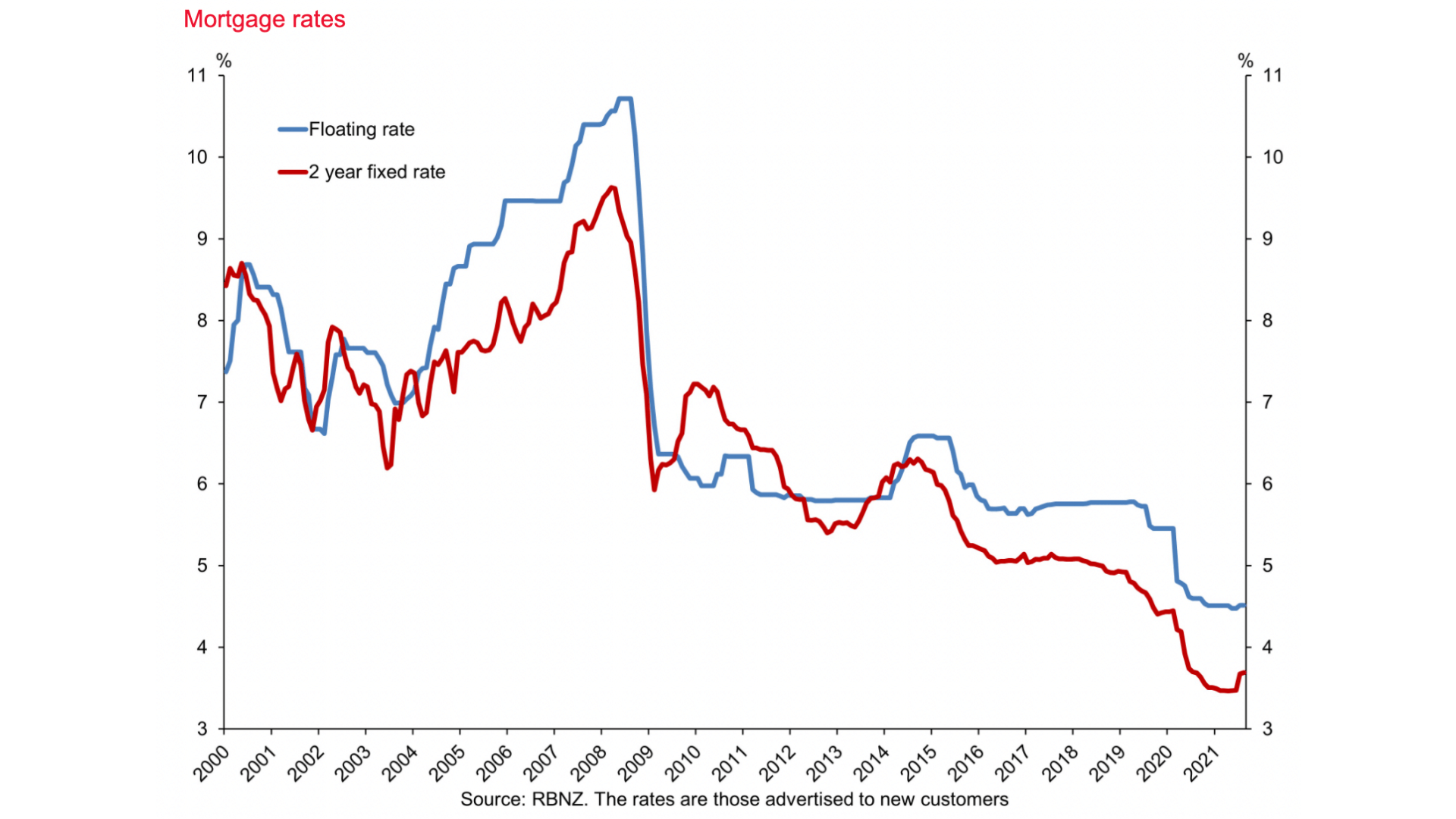
When interest rates are low, people are more inclined to borrowing money, whether it is for spending or investing. Such sentiments are resonated in the C31 form, where the number of residential mortgage borrowers doubled from May 2020 to May 2021. What is interesting here is that such an increase permeates all types of debtors; regardless of whether they are first home buyers, other owner occupiers or investors.
With such demand doubly heightened, there is an undoubtable supply side shock on the housing market, driving the prices up even further in what was already considered a bustling sector pre-Covid.
We detailed in one of our articles here, in Auckland, the median house price grew by 25% between June 2020 and 2021. This means the median price has reached $1 million+ in Auckland City, Manukau city, Rodney District and Waitakere City. The rest of New Zealand is also showing more than promising growth.
Bank lending and housing prices are of dual causality. When one increases, so does the other. The two are connected in such a manner that they propel each other.
Whilst the public sentiment is of a cautionary tale of a potential housing bubble, the cyclic effect that results from the above relationship is sure to have a lasting impact in the economy; with the real estate market looking promising in the current and upcoming financial years.
We are interested to see how the market continues to change following any upcoming shifts in interest rates and banks future decisions. We may start to see the rapid growth start to slow down with LVR restrictions tightening. As property professionals you will likely continue to see shifts in the types of buyers in the market.
For more insight into the changing property market check out these posts:
https://relab.co.nz/post/do-property-values-double-every-decade-nz
https://relab.co.nz/post/lvr-restrictions-nz
https://relab.co.nz/post/how-renting-changed-new-zealand